
Real Customer Service Rep
Serving San Francisco, Oakland, San Jose and the Santa Rosa Area
Probably the most common questions we get is, “Do you do reconstruction after you are done drying?”
We made a business decision years ago that reconstruction was not right for us. Yes, we know that
decision can make our jobs smaller and affect our bottom line. But ultimately, we chose to focus on what
we do, do it well, and leave the property owner and tenants with as little disruption as possible. We also
believe it is often better financially and, in some cases, may help an owner avoid an insurance claim.
After a water loss, demolition can feel like the safest and fastest answer. Sometimes it is necessary. But when materials are clean enough, structurally sound, accessible to drying, and capable of reaching a verified dry standard, drying them in place can protect the owner from a second wave of cost, loss of use, schedule delays, and disruption: reconstruction.
The key is not to save materials at any cost. The key is to make a careful, documented decision about
what can be safely restored and what must be removed. A restoration company that does not profit from reconstruction has a powerful reason to look harder for safe ways to preserve the building.
When the same company performs mitigation, demolition, and rebuilding, every additional material removed may create additional reconstruction work. That does not mean the company is dishonest. It does mean the business model can create a conflict that owners and managers should understand.
When a mitigation contractor does not perform reconstruction, demolition is a cost and a responsibility—not a future sales opportunity. The crew is more likely to ask practical questions: Can the drywall be dried from the back? Can baseboards be carefully removed and saved? Can cabinets be dried through a toe-kick opening? Can hardwood, framing, or concrete be restored with the right airflow, dehumidification, and monitoring?
That incentive can produce a smaller, more thoughtful scope while keeping health, safety, and industry standards first.
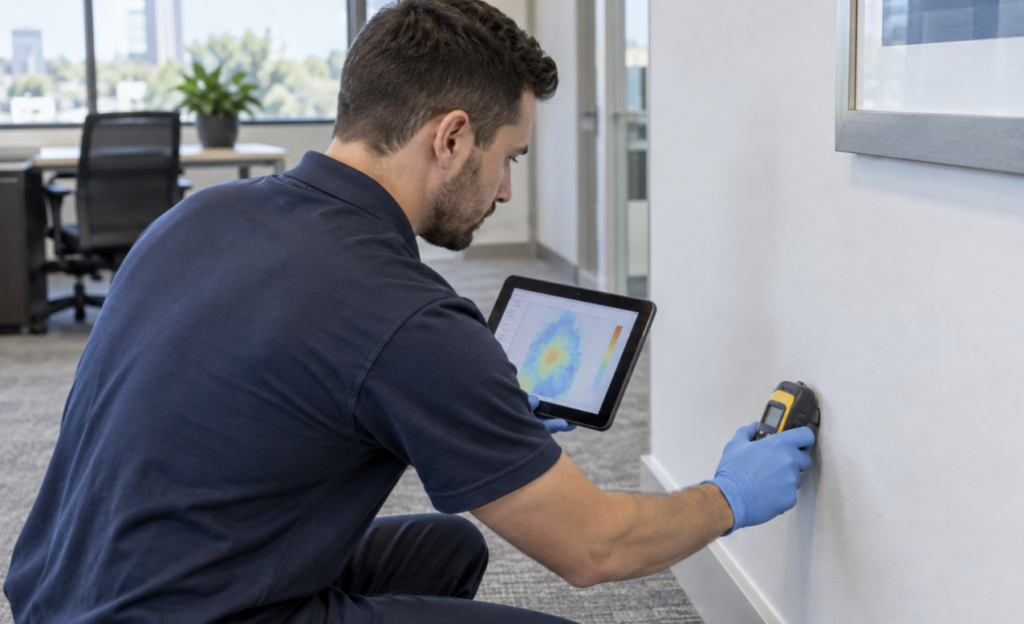
Professional drying is an active process. The crew identifies the source and category of water, maps the
affected area, extracts standing water, establishes airflow and dehumidification, opens limited drying
access when needed, and tracks moisture until the materials reach an appropriate drying goal.
A responsible contractor should be able to show the manager what was wet, what was saved, what was
removed, the reason for each decision, and the moisture readings that support completion.
Drying in place is not appropriate for every loss. Sewage and other Category 3 water can contain harmful pathogens and contaminants. Porous materials affected by Category 3 water generally must be removed and disposed of rather than dried and left in service. Materials that are deteriorated, delaminated, swollen beyond recovery, structurally unsound, mold contaminated beyond safe cleaning, or impossible to access and verify may also require removal.
Time matters. EPA guidance emphasizes drying water damaged areas and items within roughly 24 to 48 hours when possible to help prevent mold growth. Delayed discovery, warm conditions, high humidity, and trapped moisture can change what is realistically salvageable.
The final decision should account for the water category, length of exposure, material porosity, condition, building use, vulnerable occupants, applicable regulations, and the ability to clean and verify the result. Conditions can change over time. Water categories and contamination levels are covered in a separate article.
CATEGORY 3 SAFETY RULE: Porous materials affected by sewage or other Category 3 water generally must be removed and disposed of. Drying equipment does not make contaminated porous material safe to leave in service.
The owner should never receive only the conclusion, “It has to come out.” Give them the evidence and
the reasoning.
This approach turns demolition from an unexplained expense into a defensible property-management decision.
Clean or restoration material; structurally sound; reachable by the drying system; progress can be measured.
Approve a drying plan with moisture goals, monitoring, photos, and a completion record.
Small openings or selected finishes are needed to reach trapped moisture or protect assembles.
Define exactly what will be opened, saved, labeled, and reinstalled.
Category 3 contamination or porous material; material cannot be cleaned, dried, or verified; physical damage or unsafe condition.
Require the reason, evidence, safety controls, testing needs, disposal plan, and separated rebuild scope.
A professional file should tell the story of the loss from discovery through completion. It should include the source and timeline, affected-area diagram, initial and continuing moisture readings, photographs, equipment placement and monitoring records, drying goals, materials saved, materials removed, contamination controls, hazardous-material information, and final verification.
Good documentation protects the manager as much as it supports the contractor. It helps answer owner questions, supports the insurance claim, reduces disputes, and creates a record if a tenant or employee later asks what happened.
PRO TIP: Ask for two lists at the beginning of the job: “materials we expect to save” and “materials we expect to remove.” Require the contractor to update those lists as conditions become visible. This simple practice makes scope growth easier to understand and discourages demolition without a documented reason.
The best water-damage project is not the one with the least demolition or the most demolition. It is the one with the right amount of demolition.
Drying in place can lower cost, shorten downtime, preserve finishes, reduce waste, limit hazardous-material disturbance, and help occupants return sooner. But it only works when the material can be safely cleaned, dried, monitored, and verified. Sewage and Category 3 contamination, damaged materials, and inaccessible moisture require a different response.
Choose a contractor whose financial incentives support careful mitigation. When there is no reconstruction profit waiting at the end of the job, the crew has a reason to get creative about saving the property—and to give you a clear explanation when removal truly is necessary.


F&WDR is a family-owned and operated local company with four locations to insure a quicker response and better service to San Francisco, Oakland, San Jose, and Santa Rosa.

