A California field guide for property owners and managers
The First 24 Hours
Protect people first. Then document the loss and take reasonable steps to prevent additional damage when it is safe.
1.
Safety First
Follow evacuation orders. Do not enter a structure with fire, electrical, gas, structural, sewage, chemical, or mold hazards until the appropriate authority says it is safe.
2.
Notify the Insurer
Report the loss promptly. Ask what the policy requires, whether an inspection is planned, what emergency work is authorized, and how to submit documents.
3.
Document Everything
Photograph and video every affected area, damaged contents, and serial numbers. Keep a written timeline and copies of every communication.
4.
Prevent Further Loss
Emergency extraction, board-up, tarping, and drying may be needed. Preserve samples when practical and keep all mitigation receipts.
Build One Organized Clam File
Policy and declarations; claim number and adjuster contacts.
Photos, videos, inventories, estimates, receipts, and temporary-housing records.
Contracts, change orders, invoices, lien releases, permits, and inspection records.
A dated communication log showing who said what and what information was requested.
Important Balance: Do not delay work needed to protect health or prevent additional damage. When safety permits, give the insurer a reasonable opportunity to inspect before permanent repairs or disposal; photograph and record anything that must be removed first.
Choose Carefully - And Put It In Writing
Before Hiring:
Verify the contractor’s California license, classification, bond, and workers’ compensation information through CSLB License Check.
Confirm the business name and personnel match the contract. A salesperson negotiating or signing may need Home Improvement Salesperson registration.
Compare written estimates by scope, equipment, quantities, permits, schedule, exclusions, warranty, and payment terms – not only total price.
Check recent references independently and verify insurance directly with the carrier or producer.
Down Payment
A home-improvement down payment generally may not exceed $1,000 or 10% of the contract price, whichever is less. Later payments cannot exceed the value of work performed or materials delivered.
Disaster Rebuilding
CSLB advises that rebuilding after a declared disaster is a home-improvement project and must use a fixed-price contract. Not a time-and-materials or cost-plus arrangement.
Cancellation Rights
Most qualifying home-solicitation/home-improvement contracts include a 3-business-day cancellation right. California provides 5 business days when the buyer is age 65 or older and 7 business days for covered repair or restoration contracts arising from a declared emergency. Follow the written cancellation notice supplied with the contract.
The written contract should include:
License and salesperson information; exact scope and materials; approximate start/completion dates.
Total price and progress-payment schedule; permits; change-order procedure; warranties and required notices.
No blank spaces. Keep a completed signed copy before work begins.
Keep the Claim Moving - Withough Being Rushed
Company Adjuster
Works for the insurer. The policyholder is not separately charged for the company adjuster's claim service.
Public Adjuster
Licensed by CDI and hired by the policyholder. Verify the license and understand the fee, services, and cancellation rights.
Attorney
Represents the client under a written fee agreement. Verify California license and discipline history with the State Bar.
Keep the Insurance Claim Moving
Read coverages, exclusions, deductibles, endorsements, duties after loss, and deadlines; ask for a certified policy copy when needed.
Send important questions and documents in writing. Retain proof of delivery and request written explanations for major claim decisions.
Ask every contractor, adjuster, consultant, and attorney whom they represent, how they are paid, and whether they receive referral fees.
Public-Adjuster Protection: For a declared catastrophic disaster, California law limits certain public-adjuster compensation to 10% of the settlement for one year after the loss declaration, subject to statutory details and exceptions.
Pause When the Pressure Rises
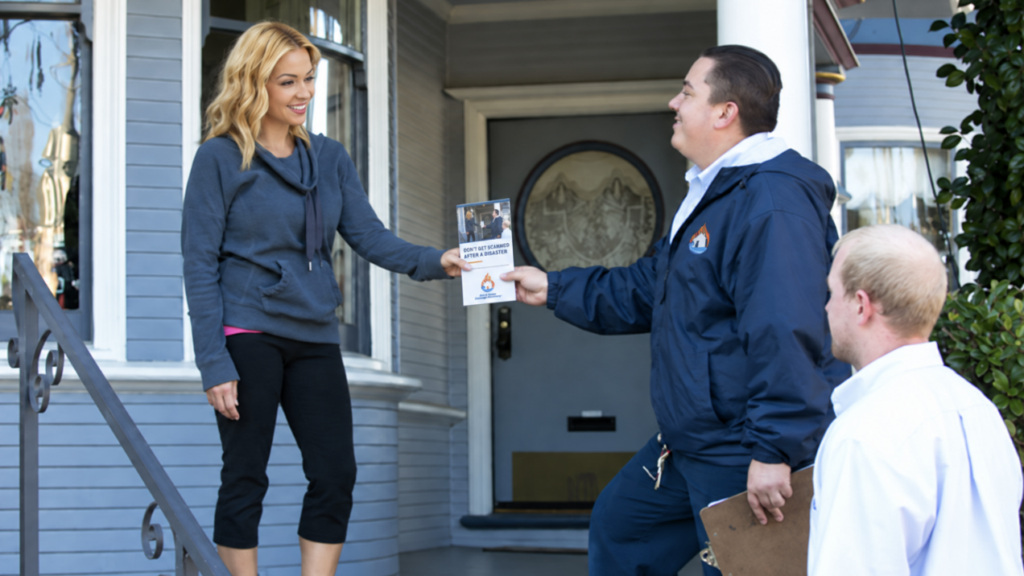
Unsolicited door-to-door pressure, or claims that an insurer already approved everything.
Requests for cash, a large deposit, front-loaded payments, or endorsement of an insurance check.
A mismatched or out-of-state license, refusal to show identification, or an offer to waive a deductible or create a false invoide.
A vague estimate, no local address or references, unusually low pricing, or billing for work or equipment not supplied.
Price-Gouging Protection
After a declared emergency, Penal Code section 396 generally restricts increases above 10% for specified goods and services unless increased costs can be proved. Coverage periods vary.
Report Concerns
Contractor Activity: CSLB. Insurance or public-adjuster issues: CDI. Price gouging: local district attorney or Attorney General. Immediate threats: law enforcement.
Urgency is Not a Reason to Surrender Verification.
Official resources worth keeping:
√
California Department of Insurance
800-927-4357 • Claims, licenses, public adjusters, complaints and fraud.
√
Contractors State License Board
800-321-2752 • Disaster Hotline: 800-962-1125 • License checks and complaints.
√
State Bar of Califonria
800-843-9053 • Attorney license, discipline history and complaints.
√
California Attorney General
Price-gouging information and consumer complaint resources.
√
CAL FIRE
Wildfire preparedness, incident information and recovery resources.
Additional CDI Tools:
Catastrophe preparation organized by wildfire, earthquake, and flood.
Wildfire recovery assistance. Safer from Wildfires information discounts, and nonrenewal-moratorium resources.
Home Insurance Finder, carrier contact, premium and coverage comparison tools.
FAIR Plan and Difference in Conditions guidance when standard residential coverage is difficult to obtain.
Residential Insurance Policy Locator when policy records are lost or the insurer is unknown.
Important: General educational information only – not legal, insurance-coverage, engineering, environmental, or tax advice. Conditions, policies, emergency orders, and laws vary. Confirm current requirements with the responsible agency or a qualified professonal.
Final Thoughts
Protect people, document the loss, prevent additional damage, verify credentials, and keep major decisions in writing. Fire & Water Damage Recovery focuses on mitigation and cleanup – not reconstruction – so our goal is to stabilize the property with as little disruption as conditions allow.