
Real Customer Service Rep
Serving San Francisco, Oakland, San Jose and the Santa Rosa Area
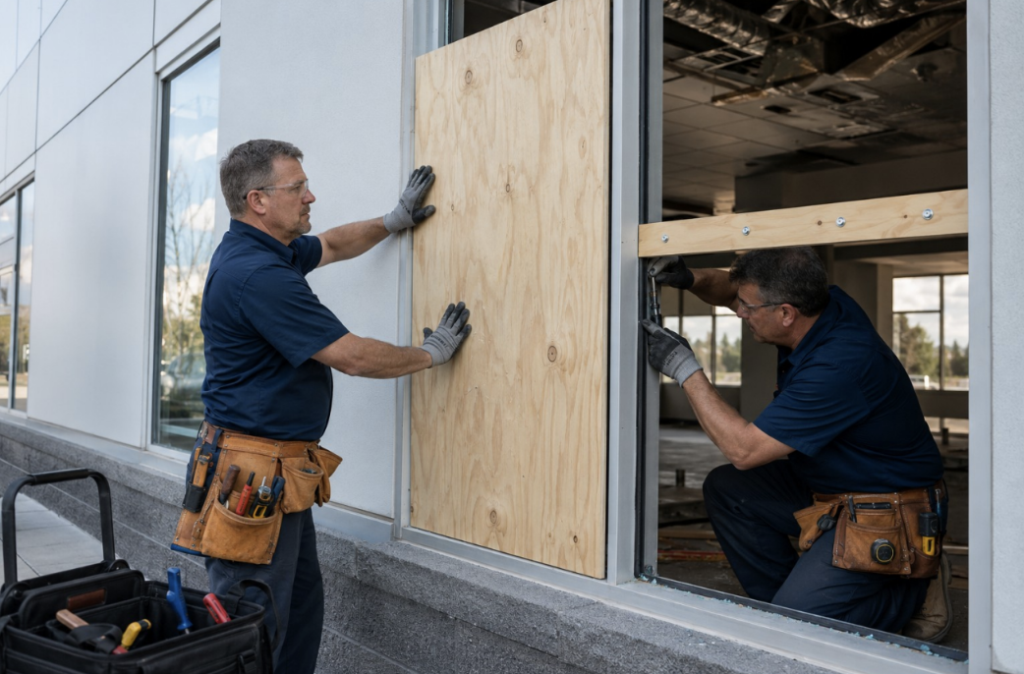
Everyone knows what an ambulance chaser is, but I was astonished to learn that there are fire chasers as well. If you ever have a fire at one of your properties, you may be shocked to learn about it from a restoration contractor. I do not know how they find you and get your number, but they will tell you anything to get permission to board up the property and take care of the damage. They are commissioned salespeople, and their company might be great or might be terrible—but you definitely do not want to make any big decisions until you have had time to think. Finding and vetting a contractor that performs board-ups correctly is best done ahead of time.
The goal is not simply to cover the opening. A professional board-up should:
After a fire, the fire department or another public agency may restrict access because of structural instability, active utilities, hazardous materials, or an ongoing investigation. After a break-in, law enforcement may need to photograph the scene, collect fingerprints, review video, or preserve other evidence.
Do not allow a board-up contractor, maintenance employee, or other vendor to begin moving debris or altering the opening until the appropriate authority has released the affected area.
Important: A rushed response that destroys evidence or exposes people to unsafe conditions can create problems far more serious than the original broken window.
Pro Tip: Lead, asbestos, and other hazardous materials can become airborne during a fire. Review the Hazardous Materials blog and arrange appropriate testing before allowing tenants into the affect space to retrieve their belongings.
Write down the date, time, location, people present, and reason for the board-up. Save police reports, fire department incident numbers, contractor reports, invoices, access logs, and communications with the owner and insurance company.
One of the most common board-up mistakes is installing plywood with screws that can be removed from the exterior. If the screw heads are accessible, an intruder may be able to remove the plywood with an ordinary drill or screwdriver. The opening may look covered, but the property is not truly secure.
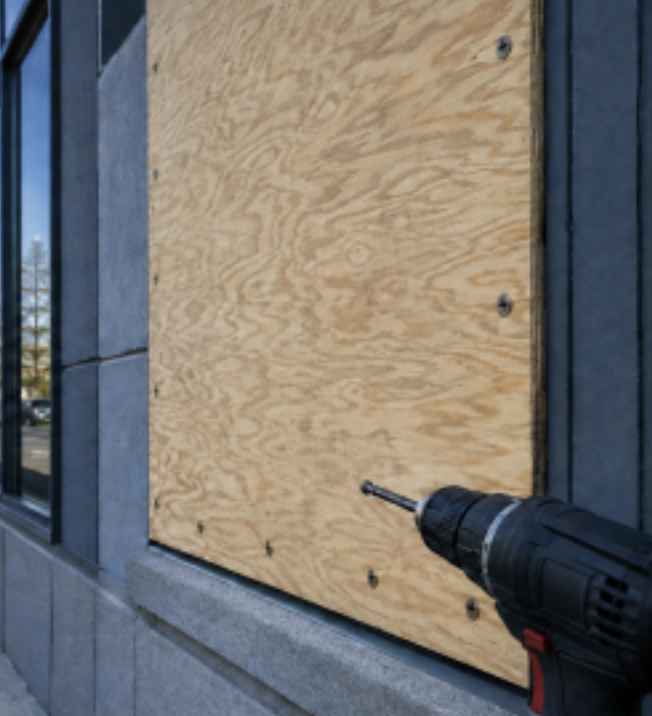
Visible screw heads can be removed from outside with an ordinary drill. Covering an opening is not the same as securing it.
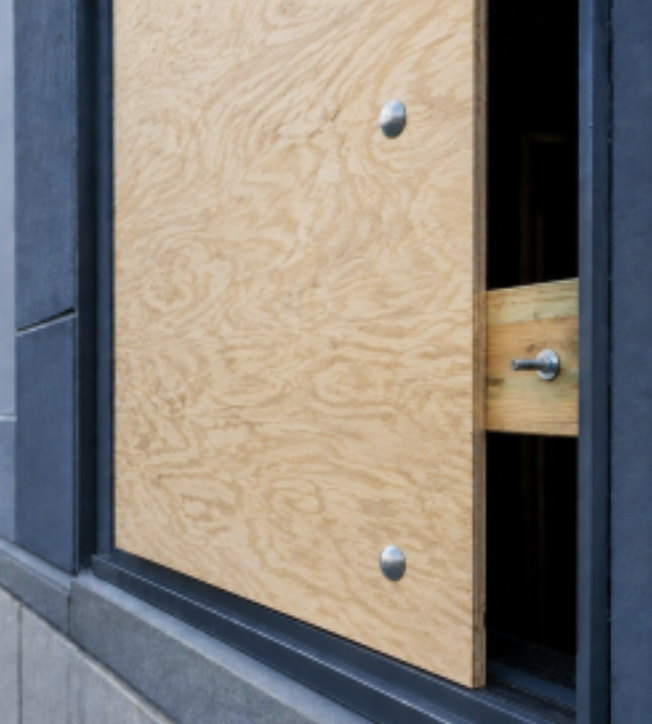
Only smooth, rounded carriage-bolt heads are exposed outside. Bolts pass through to a sturdy interior brace.
A stronger method uses plywood on the outside and an interior brace secured with bolts. From outside, only the smooth, rounded heads of the carriage bolts are visible. Because there are no exterior screw heads or nuts to grip, the assembly is much more difficult to remove from the street side.
The interior bracing distributes pressure across the opening and allows the board-up to be secured without relying solely on exterior screws. The exact method must be selected for the opening, surrounding materials, security risk, and site conditions.
A board-up is supposed to prevent additional damage—not create it.
An inexperienced contractor may begin drilling wherever it is easiest without considering what will eventually need to be repaired or replaced. Drilling into window frames, storefront systems, finished masonry, decorative trim, waterproofing assemblies, or exterior cladding can turn a temporary security measure into a major repair project.
Damage may include:
A careless board-up can cost far more to repair than the broken glass that caused the emergency call. Before drilling, the contractor should understand how the opening is constructed, identify the surrounding materials, and choose a fastening method that provides security while minimizing permanent damage.
Pro Tip: Before authorizing a board-up, ask the contractor exactly where they intend to drill and how the plywood will be secured. If the answer is unclear, or the plan is simply to drive screws into the window frame, stop and request a better method.
The plywood, bolts, bracing, and other materials should be appropriate for the size and location of the opening. A professional contractor should consider:
Plywood should cover the entire opening and should not leave gaps that allow hands, tools, rain, or animals to enter. Sharp edges, loose glass, protruding fasteners, and unstable materials must also be addressed.
Securing the property cannot come at the expense of life safety. Board-up work must not improperly block:
If the building remains occupied, the property manager should coordinate with the fire department, building official, security personnel, and other qualified professionals as appropriate. If safe egress cannot be maintained, portions of the building may need to remain unoccupied until a suitable solution is established.
A damaged opening may contain loose glass above the frame, fragments embedded in flooring, or sharp pieces hidden in landscaping and personal property. The work plan should address:
Simply installing plywood over unstable glass can leave a serious hazard behind the board.
Boarding may discourage entry, but it does not automatically make the building weather-tight. After a fire or break-in, managers should evaluate whether the opening needs additional temporary weather protection.
Notify the owner’s insurance carrier or broker as soon as reasonably possible. Ask what documentation is required and whether the carrier wants to inspect the opening before damaged materials are discarded.
Keep records of:
Emergency work should be documented carefully, but it should not be unnecessarily expanded. The purpose is to stabilize and protect the property until the permanent repair scope can be evaluated.
A temporary board-up should not be installed and forgotten. Assign someone to inspect it regularly and after:
Look for loose plywood, exposed gaps, water entry, damaged bolts, attempted removal, unstable glass, and new damage around the opening. Document each inspection and any corrective work.
After a fire or break-in, property managers are under pressure to act quickly. Speed is important, but a fast board-up that is insecure or destructive is not a successful emergency response.
The building must first be released and documented. The opening must then be secured in a way that resists removal from outside, protects people and property, and avoids unnecessary damage to window frames and surrounding finishes.
The best board-up contractors understand that their job is temporary stabilization. They secure the property while preserving as much of the original building as possible.
Our Approach: Fire & Water Damage Recovery provides 24/7 emergency response for Bay Area property and facility managers. Because we do not perform reconstruction, we have no incentive to make the permanent repair project larger than necessary. Our focus is on securing the property, limiting additional damage, documenting the conditions, and helping the manager and owner plan the next responsible step.


F&WDR is a family-owned and operated local company with four locations to insure a quicker response and better service to San Francisco, Oakland, San Jose, and Santa Rosa.

